
Truck Limp Mode Explained: Symptoms, Causes and What to Do Next
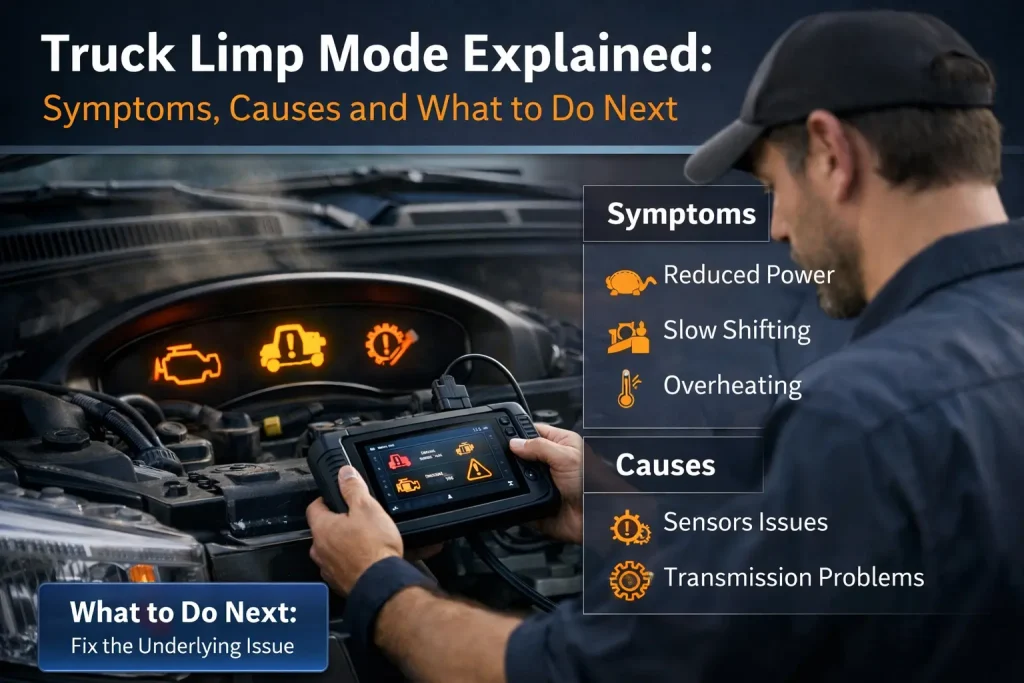
When a truck enters limp mode, every minute off the road can cost your operation time and money. For fleet managers, mine-site supervisors, and truck drivers, understanding limp mode is essential to prevent costly downtime and expensive repairs.
In this guide, you’ll learn how to spot limp mode in truck, understand the common causes, and know what steps to take immediately. Additionally, you’ll discover how mobile diagnostics and truck repair specialists can get your fleet back on the road fast.
Let’s dig in to learn everything you need to manage limp mode safely and efficiently.
What is Limp Mode?
Limp mode (also called limp home mode) is a protective “safe” mode your truck’s computer uses when it detects a serious fault; it cuts engine power, limits revs and gear changes so you can “limp” to a safe spot or workshop without making the damage worse.
The system’s goal is damage limitation. For example, it may limit torque, lock the transmission in a low gear, reduce top speed, or shut off non-essential systems until the fault is fixed. This behaviour is the same for modern passenger cars and heavy diesel trucks, but heavy-truck implementations (Scania, Cummins, etc.) also include truck-specific protections for turbo, DPF/DEF and transmission faults.
Truck Limp Mode Symptoms: How to Spot It Fast
If your truck is in limp mode, you’ll notice obvious performance limits plus changes to auxiliary systems. Read this to recognise limp mode immediately and act safely.
- Severe power reduction / limited RPM: engine revs are capped (often around 1,000–3,000 rpm depending on model). You’ll feel the truck struggle to accelerate.
- Limited top speed: vehicle speed may be constrained; commonly equivalent to roughly 50–80 km/h (30–50 mph) on many systems, but heavy trucks under load may be limited even lower.
- Locked or stuck gear selection: transmission may refuse to shift above a low gear (held at 2nd–3rd) to prevent further damage.
- Warning lights / dash messages: a Check Engine, transmission or DPF warning usually accompanies limp mode; some trucks show a “Limp Home” message. Take photos of the dash codes and messages.
- Disabled auxiliary functions: non-essential features (A/C, infotainment, PTO) may switch off to conserve power or protect systems.
- Unusual noises or smoke under load: turbo whistle, white/black smoke or rough running often point to turbo, fuel or DPF problems that trigger limp mode.
Common Causes of Limp Mode in Trucks (And How to Fix It)
Limp mode on a truck is almost always a symptom. The ECU limits power to protect the engine or transmission. The usual culprits on heavy diesel trucks are overheating, sensors, emissions (DPF/EGR), turbo/boost faults, transmission problems, oil or fuel supply issues, electrical/wiring faults, or a failing ECU.
Below we’ll break down each cause clearly, explain how to fix it and how a mechanic diagnoses it.
1- Engine Overheating
High coolant or engine temperature will prompt the ECU to reduce power immediately to avoid piston, head gasket or turbo damage.
How to Fix it: Top up coolant only when safe, replace faulty thermostat/water pump, clear radiator blockages or replace cooling fan. For mining/heavy haul trucks, urgent onsite attention prevents long site downtime.
How mechanics check it: Inspect coolant level, radiator, hoses and thermostat; use an IR thermometer to check hot spots; read coolant temperature live data via truck diagnostics.
2- Faulty Sensors (MAF, MAP, TPS, Temp & Boost Sensors)
Bad sensor readings make the ECU think the engine is outside safe limits; that triggers limp mode. Sensors commonly fail from contamination, wiring or connector issues.
How to Fix it: Clean or replace the sensor, repair corroded connectors, or clear wiring faults. On-site replacement is usually fast if the correct part is available.
How mechanics check it: Use a scan tool to view live data (MAF/boost/coolant readings), back-probe connectors, and perform resistance/voltage tests.
3- Transmission Faults & TCM Issues (Stuck Gears, Slips)
The transmission control module (TCM) or mechanical transmission faults often force the truck into a low-gear protective mode. Drivers see it as “stuck gear” or inability to shift.
How to Fix it: Reprogram or replace TCM, top up/replace fluid, repair wiring, or undertake mechanical transmission repairs. Many transmission checks can be started onsite but major rebuilds need a workshop.
How mechanics check it: Read transmission fault codes, inspect fluid level/condition, check wiring/connectors to the TCM and perform pressure tests.
4- DPF / EGR / Emissions System Failures
Blocked DPF, failed differential pressure sensors, or EGR faults can trigger limp mode to protect the engine and emissions system. Diesel trucks often limit power during failed regen cycles.
How to Fix it: Forced DPF regen (if safe), clean or replace DPF or EGR components, replace sensors. Repeated DPF failures often need a deeper exhaust system clean or injector check.
How mechanics check it: Scan for DPF/NOx/EGR fault codes, read exhaust temperatures and back-pressure, and inspect EGR and differential pressure sensors.
5- Turbo / Boost Pressure Loss
Leaks in boost hoses, intercooler damage, or turbo actuator faults cause underboost (or overboost) errors — the ECU responds by limiting power.
How to Fix it: Replace or repair boost hoses, intercooler cores, or turbo actuators; replace turbocharger if failed. Many boost issues can be diagnosed and temporarily remedied onsite to get you moving.
How mechanics check it: Pressure/boost tests, smoke tests for leaks, inspect intercooler and turbo actuator operation, and check live boost readings.
6- Low Oil Pressure or Lubrication Problems
Low oil pressure risks catastrophic engine damage; limp mode protects the engine by reducing load.
How to fix it: Top up or change oil, repair leaks, replace low-pressure senders or oil pump if required. Don’t drive long distances with low oil pressure.
How mechanics check it: Check oil level and condition, test oil pressure with a gauge, inspect for leaks and oil pump condition.
7- Fuel Delivery Issues (Filter, Pump, Injectors)
Incorrect fuel pressure or injector faults starve the engine or cause misfire; ECU limits power to protect components.
How to fix it: Replace clogged filter, repair/replace pump or injectors. For Perth operators, mobile techs can often swap filters onsite and perform a quick pressure test.
How mechanics check it: Fuel pressure tests, inspect/replace filters, test injectors and fuel pump operation.
8- Electrical, Wiring or Connector Faults
Intermittent wiring, corroded pins or damaged CAN bus lines cause false readings and communication errors that trigger limp mode.
How to fix it: Repair or replace wiring looms, clean connectors, secure grounds and protective sheathing. These fixes are commonly done onsite if access is available.
How mechanics check it: Pin-check connectors, continuity tests, and scan for CAN/communication faults using a diagnostic tool.
9- Faulty or Corrupted ECU
If the ECU itself malfunctions, it can enter a protective state. Reflashing or replacement is sensitive and must be handled by experts.
How to fix it: Reprogram (reflash) the ECU or replace it, usually workshop-level work with OEM tools. For Scania trucks, technicians follow specific “limp home” procedures in the operator manuals.
How mechanics check it: Read historical fault codes, check for firmware updates, use manufacturer tools (e.g., Scania SDP3) to test ECU health.
What to Do When Your Truck Goes into Limp Mode
Pull over safely, don’t continue under heavy load, record dash warnings, check basic fluids only if safe, and call a Perth mobile diagnostics team as many limp-mode faults can be assessed and sometimes fixed onsite.
Follow these steps to prevent further damage and to speed up truck repair and maintenance.
- Get to a safe spot – park off the road or site work area and apply parking brake.
- Note exactly what the dash shows – take photos of warning lights/messages and record time/location (use GPS).
- Turn off non-essential loads (A/C, PTO) and allow engine to idle/cool if overheated – never open a hot radiator cap.
- Check basic fluids only if safe – oil and coolant level look-only; do not attempt complex checks on-site if you’re not trained.
- Try a simple restart only once (some transient faults clear) – if limp mode returns, stop and don’t continue driving.
- Call for truck diagnostics – request an OBD scan and live-data read; mobile technicians in Perth can perform a scan and initial repairs onsite to avoid towing.
Practical Note for Fleet Managers & Mine-Site Supervisors
If a truck is entering limp mode at a mine site or on a remote haul, document dash codes and exact location, then call a mobile diesel technician to save towing time and reduce downtime for your fleet. Perth fleet care specialists can do initial truck repair and maintenance onsite and get the asset back to work faster.
Stranded with a truck in limp mode and watching downtime, fines or lost shifts pile up on-site?
Get Fast Mobile Truck Diagnostics at West Fleet Care
When your truck is in limp mode, every minute off the road costs your operation. At West Fleet Care, our experienced technicians perform rapid truck diagnostics and offer same-day truck repair and maintenance.
Our fleet care experts read fault codes onsite, run live-data checks, perform safe forced DPF regens, repair sensors, fix boost leaks, and carry common parts so we can often repair your truck without towing.
Book Onsite Truck Diagnostics Now
FAQs
- What does it mean when a truck goes in limp mode?
When a truck goes into limp mode, its engine control unit (ECU) has detected a fault and automatically limits power, speed, and gear changes to protect the engine or transmission. This “safe mode” allows you to drive slowly to a safe location or workshop without causing further damage. It signals that truck diagnostics and professional repair are needed immediately to prevent costly downtime.
- Can I drive my truck if it goes into limp mode?
Only for a very short, slow trip to a safe location or workshop. Don’t continue under heavy load. If your truck is in limp mode, stop in a safe place, record any dash messages and call a Perth mobile diagnostics team to avoid further damage.
- How do I get my truck out of limp mode?
The correct fix starts with a scan. A technician will run truck diagnostics (read fault codes + live data) to identify the cause, then repair or replace the faulty component. Temporary restarts sometimes clear transient faults, but they don’t fix the underlying issue.
- Can limp mode damage the engine or transmission?
Yes. Driving long distances in limp mode can worsen engine, turbo or transmission damage. Limp mode protects the vehicle, but ignoring it can increase repair time and costs. Arrange professional truck service and repair right away.
- What are the causes of a truck entering limp mode?
The most common triggers are faulty sensors (MAF, MAP, temp), DPF/EGR faults, turbo/boost leaks, low oil pressure, or transmission/TCM errors. Diesel-specific issues like failed DPF regen are common in fleet trucks.
- Can a mobile mechanic fix limp mode on site in Perth?
Yes. Mobile teams can perform an OBD scan, live-data checks, sensor swaps, boost-leak patches and forced DPF regens onsite. Major transmission or ECU replacements may still require a workshop or tow.