
A Complete Guide On How You Can Jump Start a Truck
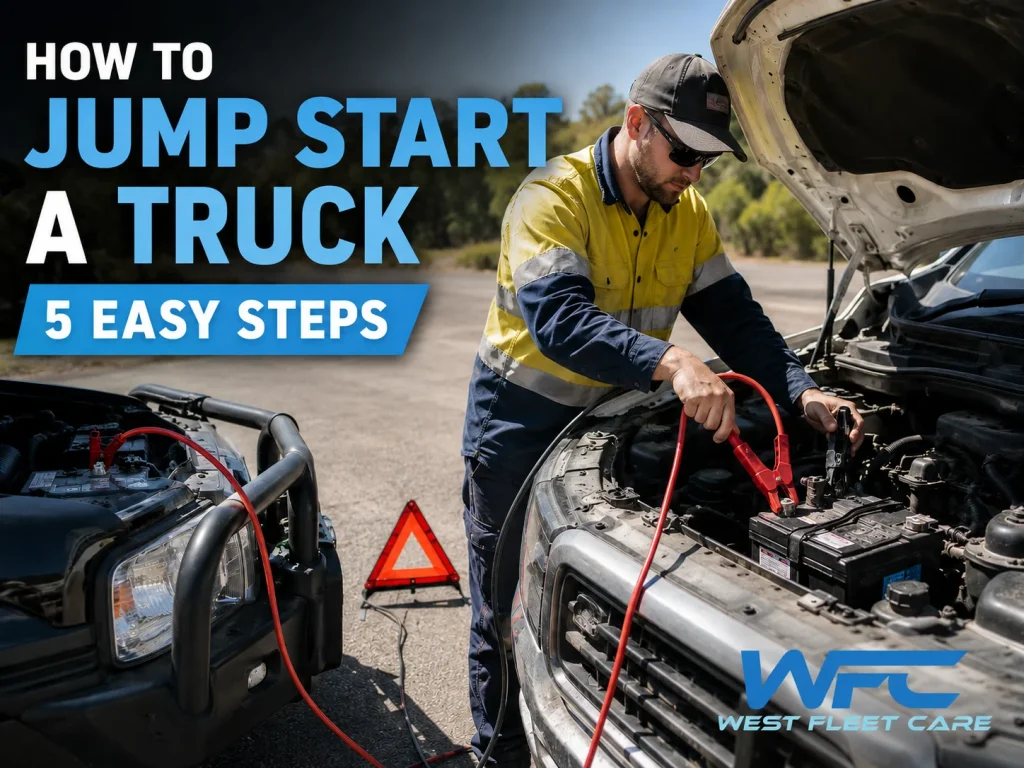
You can safely jump-start a truck by connecting the positive and negative terminals correctly, using heavy-duty jumper cables, and following the proper starting sequence to avoid electrical damage.
In this guide, we will tell you the truck battery basics first, then the pre-start checks and the exact jump-start process. Furthermore, what to do if the truck still will not start, and what to do once it finally starts. So let’s begin.
Truck Battery Basics
Heavy trucks do not run the same battery setup as a passenger car. Large diesel engines need much more starting power than a normal ute or sedan. Instead of one 12V battery, many trucks use two 12V batteries connected together in series, which creates a 24V system.
When you see two batteries, they are not separate. In a series setup, both batteries work together as one 24V starting system. The free positive terminal on one battery and the free negative terminal on the other battery are the main connection points for the truck. Connecting to the wrong terminals can leave you feeding only 12V into a system that needs 24V to wake up.
Another thing worth understanding is the difference between a flat battery and a damaged battery.
A flat battery shows familiar symptoms:
- Slow crank
- Clicking starter
- Dim dash lights
- Weak headlights
- No power under load
A damaged battery looks different. Swollen case, leaking acid, cracked housing, burnt smell, or heavy corrosion around the terminals. That is not a jump-start situation anymore. That is a replacement problem.
Pre-Safety Check Before Jump Starting
Do not grab the jumper leads immediately. Spend one minute checking the setup first. It saves a lot of trouble later.
Start by confirming the truck actually uses a 24V system. Most heavy trucks do, but not all dual-battery vehicles are wired the same way. Some lighter diesel trucks still run 12V systems with batteries connected in parallel instead of series.
Next, check the donor source.
The donor truck or jump pack must match the truck voltage. A standard 12V car is not the right donor for a 24V heavy truck. Even if you somehow get partial power across, it will not crank properly and can create electrical headaches you do not want.
Then check the battery itself.
Look for:
- Cracked battery casing
- Leaking acid
- Badly swollen battery
- Loose terminals
- Burnt cables
- Green or white corrosion buildup
If the terminals are dirty, clean enough metal so the clamps can bite properly. Weak contact points kill jump starts faster than people realise.
Now check your jumper leads. Heavy trucks need heavy-duty cables. Thin passenger-car leads are useless on a large diesel because the starter draw is far higher. Thick-gauge cables transfer power properly and stay cooler under load.
Finally, locate a proper earth point on the truck before you start connecting anything. A solid unpainted metal point on the engine block or chassis is ideal. Not a random bracket. Not a painted guard. Not some dirty latch point covered in grease.
That earth point matters more than people think.
How to Jump Start a Truck | 5 Steps
Step 1: Identify the Battery Connection Points
Open the battery compartment and identify the main positive and negative points of the truck system.
On 24V trucks, the batteries are wired in series:
- Positive of Battery 1 links to negative of Battery 2
- The remaining free terminals become the truck’s main 24V positive and negative points
You need to connect to those actual system terminals, not the middle link between the batteries.
If you are unsure, stop and check the battery diagram or manual first. Guessing here is how people melt clamps or feed the wrong voltage into the system.
Step 2: Connect the Jumper Leads
Now connect the leads in this order:
- Red clamp to the truck’s positive terminal
- Other red clamp to the donor positive terminal
- Black clamp to donor negative terminal
- Final black clamp to the truck earth point
That last connection matters. The final black clamp should go to a proper engine or chassis ground point, away from the battery itself. This reduces spark risk around battery gases and gives a cleaner ground path.
Make sure every clamp is gripping clean metal properly. A loose clamp creates resistance, heat, and poor current flow.
This is where cheap jumper leads fail. Thin clamps and weak cable thickness simply cannot carry enough current for a heavy diesel crank.
Step 3: Start the Donor Power Source
Once the cables are connected properly, start the donor truck or activate the 24V jump starter.
Do not rush straight to the ignition key on the dead truck.
Let the donor source feed power into the flat batteries for a few minutes first. Large diesel engines pull huge currents on startup, and a deeply discharged truck battery needs a small charge boost before it has a realistic chance of cranking properly.
If you are using a jump pack, make sure it is actually rated for 24V heavy vehicles. A small lithium car jump starter is not built for a prime mover or large diesel engine.
Step 4: Start the Truck
Now crank the truck.
Keep the attempt controlled. Short, solid crank attempts are better than sitting on the starter motor endlessly.
If the truck starts, great. Let it idle.
If it struggles badly, slows down instantly, or only clicks again, stop and reassess instead of cooking the starter motor.
At that point, the problem could be:
- Weak donor battery
- Poor earth connection
- Damaged truck battery
- Failed starter
- A serious voltage drop through bad cables
One Reddit mechanic thread highlighted a truck that still would not start after battery replacement because there was an 11.5V drop between the batteries and the starter due to cable damage. That kind of hidden resistance problem is more common than people think.
Step 5: Remove the Leads in Reverse Order
Once the truck is running properly, disconnect the jumper leads in reverse order:
- Black clamp from the truck earth point
- Black clamp from donor negative
- Red clamp from donor positive
- Red clamp from truck positive
Keep the clamps separated while removing them. One accidental touch between leads can turn a simple job into a very bad afternoon.
What to Do If the Truck Does Not Start
If the truck still refuses to fire after a proper jump-start attempt, stop forcing it.
Repeated cranking does not magically fix a dead battery or bad starter. It just overheats components and drains the donor source as well.
At that stage, check:
- Voltage match
- Clamp contact quality
- Earth Point cleanliness
- Battery condition
- Cable damage
- Starter motor operation
A weak earth connection is a huge one. Trucks live hard lives. Dirt, vibration, corrosion, oil, and weather eventually attack battery cables and grounding points.
A badly sulphated battery can also refuse to accept a charge even when connected correctly. Once batteries reach that stage, jump-starting becomes inconsistent or impossible.
Another common mistake is using underpowered equipment. Large diesel trucks need a serious starting current. Some heavy-duty systems pull massive amperage under load, especially in cold weather.
If the cables feel hot quickly, the donor source struggles heavily, or the truck still shows almost no crank speed, stop and reassess rather than continuing blindly.
What to Do After the Truck Starts
Once the truck is running, do not shut it off immediately.
The alternator now needs time to recharge the batteries properly. Let the truck idle briefly, then drive it long enough to build real charge back into the system. A five-minute idle is not enough for a heavily discharged truck battery.
Pay attention to the dash as well.
If the battery warning light stays on, or if the truck struggles again shortly after shutdown, there is probably a charging-system issue underneath the flat battery problem.
Sometimes the battery itself is simply old and tired. Sometimes the alternator is weak. Sometimes the cables are corroded internally, even when they look decent outside.
And honestly, truck batteries give warning signs before they completely die:
- Slower crank in the morning
- Dimmer lights during startup
- Struggling after sitting unused
- Needing repeated jump starts
- Random electrical dropouts
Ignore those signs long enough, and eventually the truck chooses the worst possible moment to stop starting.
Keep Your Truck Moving with West Fleet Care
At West Fleet Care, we handle truck repairs in Perth. From jump-start issues to deeper electrical faults, our expert team works on heavy vehicles with the kind of experience that keeps fleets road-ready.
One quick check today can save a longer breakdown tomorrow.
Call Us Now 0423 858 801
FAQs
Can you jump-start a truck with a car?
Not if the truck is a 24V heavy vehicle and the car is 12V. The donor source has to match the truck’s operating voltage.
Where does the black jumper lead go on a truck?
To a solid earth point or exposed metal part of the engine/chassis, away from the battery and fuel system.
Why do trucks use two batteries?
In many 24V systems, two 12V batteries are connected in series to create the voltage needed for heavy starting loads.
Can a jump starter power a truck?
Yes, if it is a unit made for the truck’s voltage and starting demand. A small car jump pack is not the same thing as a heavy-duty 24V unit.
Why does the truck battery keep going flat?
Loose terminals, corrosion, undercharging, overcharging, sulphation, vibration, and long idle periods are all common causes.