
Timing Belt vs Timing Chain: A Guide for Fleet Owners in Perth, WA
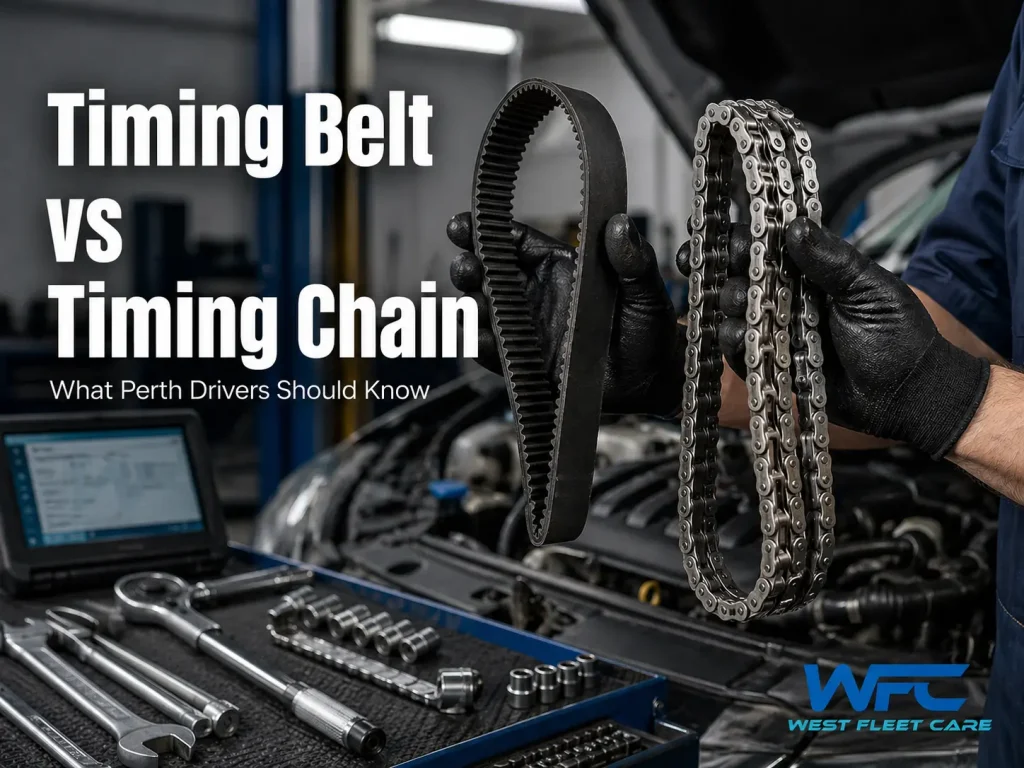
Timing belts and timing chains do the same job in a truck’s engine system, keeping the camshaft and crankshaft perfectly in sync. But they differ in material, lifespan, and maintenance requirements.
A timing belt is rubber-based and requires scheduled replacement, while a timing chain is metal-based and lasts longer with proper servicing.
For trucks and fleet vehicles in Perth, WA, this difference goes beyond basic mechanics. Your truck’s timing system doesn’t just affect engine performance; it directly impacts downtime, repair costs, and reliability, especially under harsh operating conditions like heat, long distances, and heavy loads.
That’s why choosing the right system, and maintaining it correctly, is critical for keeping your fleet running efficiently. That’s where this guide comes in.
Inside, we’ll help you explore the key differences between timing belts and timing chains. You’ll learn what’s commonly used in trucks across WA and how to choose the right timing system for your fleet.
What Is the Difference Between a Timing Belt and a Timing Chain?
The main difference between a timing belt and a timing chain lies in their material, lifespan, and maintenance requirements.
A timing belt is made from reinforced rubber, requires scheduled replacement (typically every 60,000–150,000 km), and runs quietly, while a timing chain is made of metal, lubricated by engine oil, designed for long-term use, and is generally more durable but slightly noisier.
Both have the same crucial role to play. They ensure that the engine’s camshaft and crankshaft synchronise so that the opening and closing of the engine’s valves occur at the right time.
Now, let’s go through some more details.
What Is a Timing Belt?
A timing belt is a reinforced rubber belt with teeth that grip gears connected to the camshaft and crankshaft.
- It works silently and effectively
- Typically requires replacing every 60,000 – 150,000 km or 5 – 10 years
- Is common in older cars or some smaller engines
- If broken, causes catastrophic damage to the engine
Due to its rubber composition, a timing belt becomes susceptible to heat and age in tough conditions, such as those in Western Australia.
What Is a Timing Chain?
A timing chain is a metal chain similar to a bicycle chain, located inside the engine and lubricated by engine oil.
- Durable enough to last the lifetime of an engine
- Durable and resistant to high pressure and heat
- Used frequently in modern trucks and diesel engines
- Must be maintained in terms of oil quality
Timing chains are preferred in demanding applications because they can handle continuous stress and harsh operating conditions more effectively than belts.
Quick Comparison: Timing Belt vs Timing Chain
Feature | Timing Belt | Timing Chain |
Material | Reinforced rubber | Metal (steel chain) |
Durability | Moderate | High |
Lifespan | 60,000–150,000 km (scheduled) | Lifetime (with maintenance) |
Maintenance | Regular replacement required | Depends on oil quality, engine care & servicing |
Cost (Replacement) | Lower upfront | Higher if replacement needed |
Noise | Quieter | Slightly noisier |
Failure Risk | Sudden and catastrophic | Gradual wear (usually detectable) |
Understanding these differences is important but for fleet operators, the first question is: which one is actually used in trucks across Perth, WA?
Do Trucks Use Timing Belts or Timing Chains in Western Australia?
Both timing belts and timing chains can be found in WA transport and mining. However, timing chains have become much more popular recently for modern trucks and fleet vehicles.
Even though there may still be some trucks that use timing belts, most fleet vehicles use heavy diesel engines, which means that timing chains and gear systems are commonly used. In heavy duty diesel vehicle, timing chains are preferred because they can withstand large amounts of load continuously, long operating hours, and difficult weather conditions.
This makes them more suitable for industries like mining, transport, and construction, where downtime can be extremely costly.
Why Modern Trucks Favour Timing Chains
Modern truck manufacturers have shifted toward timing chains because they offer:
- Greater durability under stress
- Less scheduled replacements
- Better performance in high-heat and long-distance conditions
- Longer service intervals
Thus, heavy diesel engines use timing chains or gear-driven systems to ensure maximum reliability and minimal maintenance interruptions.
Timing Belt vs Timing Chain in Perth Conditions: What Changes?
The climate in Perth and Western Australia greatly influences the performance of timing systems. Factors like hot temperatures, dust and dirt, long-distance travelling, and heavy duty operations may influence the longevity and effectiveness of your vehicle’s timing system.
Below are ways in which the Perth climate influences each timing systems:
Heat and Age Influence on Timing Belts
The timing belt is very susceptible to climatic factors. In Western Australia:
- The heat leads to hardening and cracking of rubber
- UV light speeds up the rate of deterioration
- The age becomes as critical as kilometres
Replacement intervals must be strictly observed to prevent unexpected failures.
Quality of Oil and Servicing for Timing Chain
Timing chains rely heavily on engine oil for lubrication and protection. Poor maintenance can lead to chain stretching, increased noise (rattling), and reduced engine performance. Regular oil changes and proper servicing are key to ensuring a timing chain reaches its full lifespan.
What Happens If a Timing Belt Breaks or a Timing Chain Fails?
If a timing belt breaks or a timing chain fails, the engine’s internal timing is immediately lost. This means the pistons and valves stop moving in sync which can lead to severe internal engine damage within seconds.
In many modern engines, especially interference engines, this results in bent or broken valves, damaged pistons, cylinder head damage, or complete engine failure in worst cases.
Why Timing Belt Failure Is Often Catastrophic
Timing belts tend to fail suddenly and without warning, especially if they are overdue for replacement. It’s because:
- Rubber can weaken over time due to heat and ageing
- Failure usually happens without gradual symptoms
- Repairs often involve major engine rebuilds or replacement
For fleet operators, this means unexpected downtime, expensive repairs, and disruption to operations.
Why Timing Chain Problems Still Matter
Timing chains are more durable, but they are not immune to failure.
Instead of snapping instantly, they usually show early warning signs, such as:
- Rattling noise from the engine
- Engine misfires or rough running
- Check engine light related to timing issues
If ignored, a worn or stretched timing chain can still lead to incorrect valve timing, reduced engine performance, and serious internal damage over time.
In Western Australia, where trucks operate under heavy loads, long distances, and high temperatures, the consequences of timing failure are even more critical. A failed timing system can take a vehicle off the road immediately. It can cause delays in mining or transport operations. Further, it can lead to high recovery and repair costs.
That is why fleet preventive maintenance is always more cost-effective than reactive repairs.
How Long Do Timing Belts and Timing Chains Last?
The lifespan of a timing belt or timing chain depends on engine design, usage, and maintenance. Although the two mechanisms perform identical functions, their behaviour differs significantly.
Lifespan of Timing Belt
Timing belts have an inherent lifespan within which they should be replaced as part of regular maintenance due to gradual deterioration. Their lifespan is about 5 to 10 years (equivalent to 96,000 to 160,000 km). Their lifespan may depend on age, exposure to the elements, heat, and operating conditions, driving patterns, and load placed on the engine.
Due to high heat exposure and extreme climate in WA, the aging of the rubber belt will be accelerated by the elements.
Lifespan of Timing Chain
Timing chains do not wear out and are built to last the engine’s lifetime (150,000–200,000+ miles). Their lifespan may be dictated by the engine oil condition. When maintained regularly, they will last long; otherwise, they will wear out prematurely or get stretched.
When to Replace a Timing Belt or Timing Chain?
Changing the components of the timing system at the correct intervals is necessary in order to prevent the engine from being damaged as well as unforeseen downtimes. The strategy varies according to whether the truck has a belt or a chain system.
When Should You Replace a Timing Belt in a Truck?
The replacement should take place after reaching an interval that the truck manufacturers recommend, which generally amounts to every 60,000 – 150,000 km or 5-7 years.
You should consider changing it sooner if:
- Signs of wear are present, including cracking, fraying or being oily
- There is incomplete servicing history on the truck
- The vehicle operates under heavy loads or is used for long distances
In the case of fleet vehicles, it is important to change the belt just before the limit to minimize the risk of sudden breakdown and subsequent costly repairs.
When Should You Replace a Timing Chain in a Truck?
The timing chain is changed when it is in need of it, depending on its condition.
You should consider changing the timing chain in the following instances:
- There is rattle during engine start-up
- The engine shows timing-related fault codes
- There is reduced performance or rough running
- The vehicle has high mileage with inconsistent servicing
Regular inspections and proper oil maintenance are essential to detect issues early and maintain reliability.
Key Takeaway:
- Timing belts = replaced on schedule
- Timing chains = replaced based on condition
Knowing when to replace your timing system is critical, but first, you need to confirm which system your vehicle uses.
How Do You Know If Your Vehicle Has a Timing Belt or Timing Chain?
The fastest and surest method for finding out whether your car has a timing belt or a timing chain is by consulting the manufacturer’s records or experts.
➣ Check Your Owner’s Manual/Log Book
The following information would be available in the owner’s manual or logbook:
- Whether your vehicle is fitted with a timing belt or chain
- Recommended replacement/overhaul period
It is always more accurate this way.
➣ Check By Make, Model, and Year of Vehicle
In cases where you lack such information because your owner’s manual is missing:
- Search online using your vehicle’s make, model, and year of manufacture
- Consult a garage using your vehicle specifications
There might be differences even between two vehicles of the same make and model.
➣ Steps If You Are in Doubt
If you remain in doubt, your best bet would be to consult an expert.
Get an expert opinion about the vehicle type and advice regarding maintenance or replacement. It is especially crucial for those managing large fleets of vehicles.
How Much Does Timing Belt or Timing Chain Replacement Cost in Perth?
In Perth, timing belt replacement is usually the cheaper scheduled job, while timing chain replacement is typically more expensive because it is more labour-intensive and tied to deeper engine work.
On average, timing belt replacement costs around $500 to $1,000, with Perth-based estimates ranging from about $520 to $1,400 depending on the vehicle and access. Timing chain replacement is usually higher, with an average of $1,200 to $2,000+.
For trucks and fleet vehicles, the final cost can sit above those averages when the engine bay is tight, the job takes longer, or extra parts need to be replaced at the same time.
What Affects the Timing System Cost?
The main cost driving factors are:
- Vehicle make and model
- Engine layout and access
- Labour time
- Workshop labour rate
- OEM vs aftermarket parts
- Whether extra parts are replaced such as the tensioner, seals, or water pump
- Urgency, especially if the vehicle is already broken down or being booked in as an emergency job
A smart way to lower the total bill is to replace related parts while the engine is already open. Expert mechanics recommend changing the water pump, tensioner, and seals at the same time, which can save labour later.
In short, preventive servicing costs less than reactive repair.
Keep Your Fleet Moving with a Timing System Inspection at West Fleet Care
If your truck, ute, or fleet vehicle is due for a timing check, do not wait for noise, rough running, or a breakdown to force the issue. West Fleet Care helps Perth businesses stay ahead of timing-related problems with practical inspections, truck repairs and maintenance support designed to reduce downtime and keep vehicles working when they should be on the road.
Book Your Truck Engine Inspection Today
FAQs
➢ Is a timing chain better than a timing belt?
For many heavy-duty engines, yes, timing chain is better because it is usually more durable and lasts longer than a timing belt. The right choice still depends on the engine design set by the manufacturer.
➢ Do timing chains need replacement?
Not usually on a fixed schedule. Timing chains are designed to last the life of the engine But they should be inspected and replaced if they stretch, rattle, or show signs of wear.
➢ Can I drive if my timing chain is rattling?
It is not a good idea. Rattling is a warning sign that the chain, tensioner, or guides may be worn, and continuing to drive can lead to costly engine damage.
➢ Is it safe to ignore a worn timing belt?
No. A worn timing belt can fail suddenly, and when it does, the engine can suffer severe internal damage.
➢ Which is more expensive to replace, timing belt or timing chain?
A timing chain is usually more expensive to replace than a timing belt. Timing belt replacement costs around $1,200 to $2,000+, while timing belt replacement is commonly $500 to $1,000, with Perth prices ranging from $520 to $1,400 depending on the vehicle.
➢ How can I tell if my truck has a timing belt or chain?
Check the owner’s manual or service logbook first. If that is not available, ask a mechanic using the make, model, year, and engine details.
➢ What is the best interval for timing system replacement in Australia?
For timing belts, many manufacturers recommend replacement around 60,000 to 150,000 km, and every 5 to 7 years, whichever comes first. Timing chains usually do not have a fixed interval unless the manufacturer specifies one; they are replaced based on condition.
➢ How much does it cost to replace a timing belt on a truck?
In Perth, timing belt replacement typically costs between $500 and $1,000, depending on the vehicle and labour involved.
➢ How much does a timing chain cost on a truck?
Timing chain replacement usually ranges from $1,200 to $2,000 or more, depending on engine complexity and condition.